
Gear Propulsion Solar Car Kit
CARSLR1
Introduction Introducción
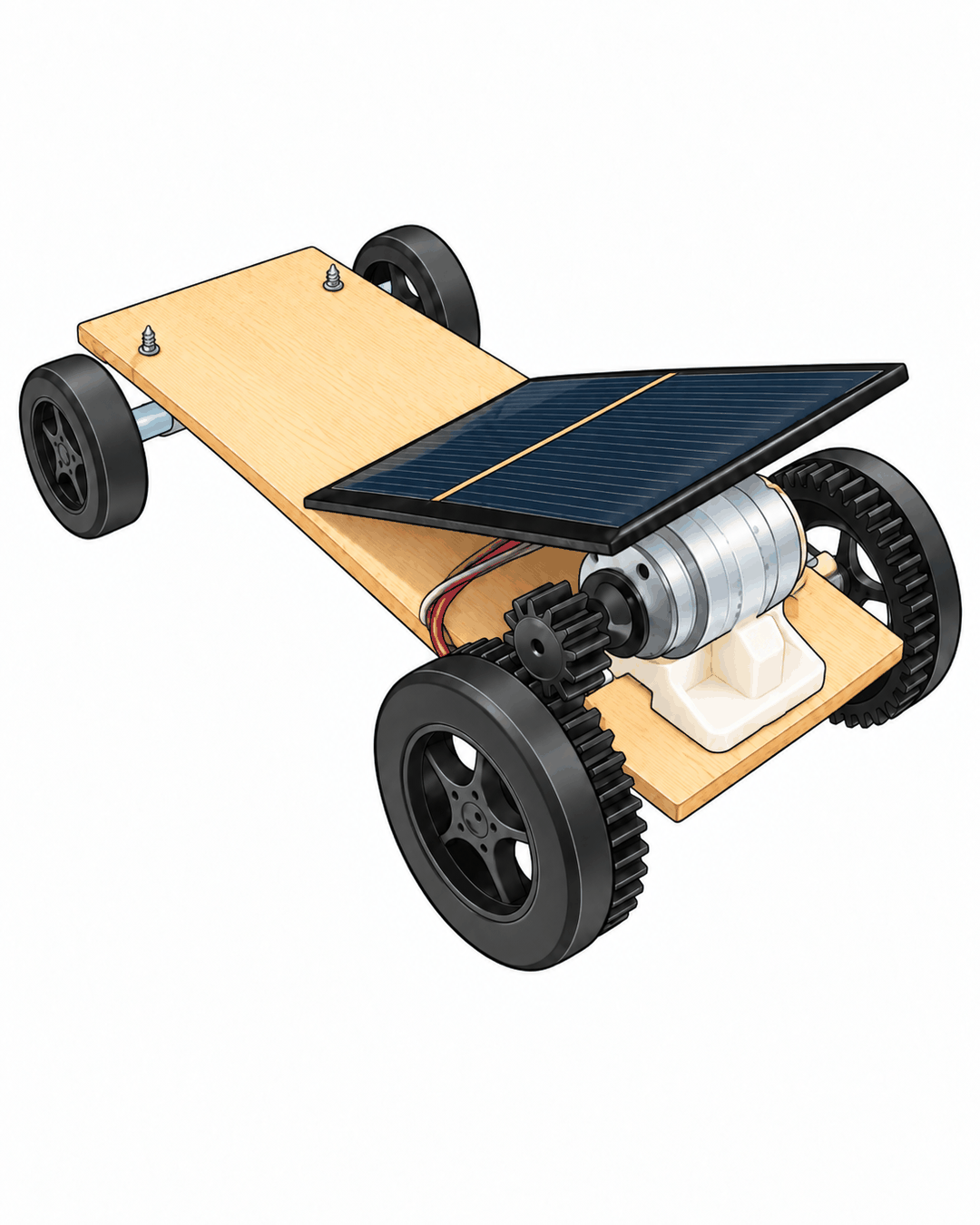
This page contains complete, bilingual online instructions for building a solar powered model car and using it for science experiments. All information is based on the materials that come in the MiniScience Gear Propulsion Solar Car Kit. If you don't have this kit, you can order one online.
Esta página contiene las instrucciones completas y bilingües para construir un carro modelo impulsado por energía solar y usarlo en experimentos científicos. Toda la información se basa en los materiales que vienen en el Gear Propulsion Solar Car Kit de MiniScience. Si no tienes este kit, puedes pedirlo en línea.
MiniScience's solar racer activity introduces students to alternative energy concepts while incorporating problem solving, design and modeling. In addition, students will experience using hand tools as they construct their solar vehicle.
La actividad del carro solar de MiniScience introduce a los estudiantes en los conceptos de energías alternativas, e incorpora la resolución de problemas, el diseño y la construcción de modelos. Además, los estudiantes aprenderán a usar herramientas manuales mientras construyen su vehículo solar.
A small solar panel turns sunlight into electricity, and a DC motor turns that electricity into motion. The motor's small gear drives the large gear built into the rear wheel, pushing the car forward with no batteries at all.
Un pequeño panel solar convierte la luz del sol en electricidad, y un motor de corriente continua convierte esa electricidad en movimiento. El engranaje pequeño del motor mueve el engranaje grande integrado en la rueda trasera e impulsa el carro sin usar ninguna pila.
With this project students can explore:
Con este proyecto los estudiantes pueden explorar:
- Alternative energies like solar power.
- Propulsion types and drive concepts: gears, pulleys and rubber bands.
- Gear alignment and gear ratios.
- Basic soldering techniques and electronic concepts.
- Design, modeling and the use of simple hand tools.
- Energías alternativas como la energía solar.
- Tipos de propulsión y sistemas de transmisión: engranajes, poleas y bandas elásticas.
- Alineación de engranajes y relación de transmisión.
- Técnicas básicas de soldadura y conceptos de electrónica.
- Diseño, construcción de modelos y uso de herramientas manuales sencillas.
Assembly video Video de armado
Video 1 — Step-by-step assembly of the solar car. Video 1 — Armado paso a paso del carro solar.
Scan here for the online video Escanea para ver el video en línea
Assembly video Video de armado
Video 1 — Assembly Video 1 — Armado
Teacher Preparation Preparación del Docente
During construction of the solar racer, students can experiment with and understand methods of power transfer, soldering (optional), gear alignment and calculating gear ratios. It is up to the teacher to make sure this background information is provided to students in some manner.
Durante la construcción del carro solar, los estudiantes pueden experimentar y comprender los métodos de transmisión de potencia, la soldadura (opcional), la alineación de engranajes y el cálculo de la relación de transmisión. Corresponde al docente asegurarse de que los estudiantes reciban esta información de base de alguna manera.
Background Antecedentes
Governments encourage alternative forms of transportation because the supply of oil is limited and pollution keeps increasing. Solar cars are one of many transportation concepts that have emerged. Solar cars use solar panels instead of gasoline as their fuel, so exhaust fumes and oil consumption are eliminated.
Los gobiernos fomentan formas alternativas de transporte porque el petróleo es limitado y la contaminación sigue aumentando. Los carros solares son uno de los muchos conceptos de transporte que han surgido. Usan paneles solares en lugar de gasolina como combustible, por lo que eliminan los gases de escape y el consumo de petróleo.
In a full-size solar car, the solar panel generates an electrical charge that is stored in a battery and used to provide energy as the vehicle is driven. The lighter the vehicle, the less energy it uses and the farther it travels. On cloudy days, or at night, energy is drawn from the reserve batteries or from roadside charging stations. Your model is simpler: the solar panel is connected directly to the motor, so the car runs only while light is shining on the panel.
En un carro solar de tamaño real, el panel solar genera una carga eléctrica que se almacena en una batería y proporciona energía mientras el vehículo circula. Cuanto más liviano es el vehículo, menos energía usa y más lejos llega. En días nublados, o de noche, la energía se toma de las baterías de reserva o de estaciones de carga junto a la carretera. Tu modelo es más simple: el panel solar se conecta directamente al motor, así que el carro solo funciona mientras la luz ilumina el panel.
Items Needed Materiales Necesarios
Before starting, verify the content of your kit against the list below. This kit has the supplies to build at least one type of solar car model. Solar cars may be propelled using a pulley and rubber band method or with interlocking gears.
Antes de comenzar, verifica el contenido de tu kit con la siguiente lista. Este kit tiene los materiales para construir al menos un tipo de carro solar. Los carros solares pueden impulsarse con poleas y una banda elástica o con engranajes que encajan entre sí.
- Solar cell (solar panel)
- DC motor
- Rear slicks, 1 9/16" diameter × 5/8" wide (1/2" wide for geared slicks)
- Front wheels, 1 3/8" diameter
- 1/8" dowels for axles
- Traction bands (for non-geared slicks)
- Eye screws, eyelets or washers
- Straw
- Wood sheet, 5" × 2" × 3/32" (or larger, so you can cut it to any size)
- Basswood stick, 5 mm × 5 mm × 20 cm
- Motor mount (with straps if needed)
- Procedure sheet
- Celda solar (panel solar)
- Motor de corriente continua
- Ruedas traseras lisas de 1 9/16" de diámetro × 5/8" de ancho (1/2" de ancho para las ruedas con engranaje)
- Ruedas delanteras de 1 3/8" de diámetro
- Varillas de madera de 1/8" para los ejes
- Bandas de tracción (para ruedas sin engranaje)
- Armellas, ojales o arandelas
- Pajilla (popote)
- Lámina de madera de 5" × 2" × 3/32" (o más grande, para cortarla a cualquier tamaño)
- Listón de madera de tilo de 5 mm × 5 mm × 20 cm
- Soporte para el motor (con cinchos si hacen falta)
- Hoja de procedimiento
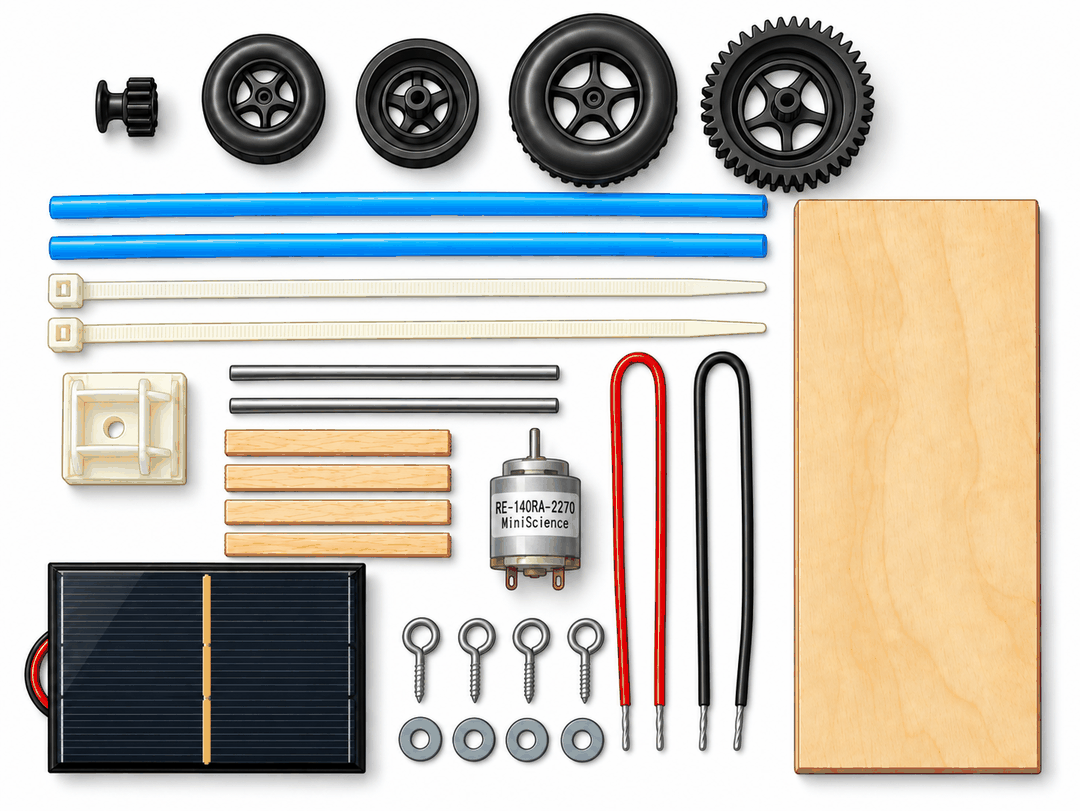
Kit content may be different from the images shown on this page.
El contenido del kit puede ser diferente de las imágenes que se muestran en esta página.
A Science Fair Project Un Proyecto para la Feria de Ciencias
The Gear Propulsion Solar Car Kit may be used for a science project, technology project, display project, or an engineering project for your science fair. Your completed car will also be an educational tool for yourself and your classmates who need to understand solar energy, the conversion of light into electrical and mechanical energy, and how gears transfer power.
El Gear Propulsion Solar Car Kit puede usarse para un proyecto científico, tecnológico, de exhibición o de ingeniería para tu feria de ciencias. Tu carro terminado también será una herramienta educativa para ti y tus compañeros que necesiten comprender la energía solar, la conversión de la luz en energía eléctrica y mecánica, y cómo los engranajes transmiten la potencia.
Propulsion Systems Sistemas de Propulsión
Propulsion systems use the solar cell and the toy motor with a:
Los sistemas de propulsión usan la celda solar y el motor de juguete con:
- Gear drive
- Pulley and rubber band drive
- Transmisión por engranajes
- Transmisión por polea y banda elástica
Advanced students are encouraged to experiment with different size pulleys and gears, if available.
Se anima a los estudiantes avanzados a experimentar con poleas y engranajes de distintos tamaños, si los tienen.
Basic Tools Required Herramientas Básicas
These items may be required to build the solar vehicle:
Estas herramientas pueden ser necesarias para construir el vehículo solar:
- Craft knife, used to cut or trim soft wood (not included)
- White glue, wood glue or glue gun (not included)
- Soldering iron, needed only if you want to solder the wires (not included)
- Pliers, used to connect and twist wires together if needed (not included)
- Ruler, used for measurements (not included)
- Pencil, used for marking (not included)
- Cúter o cuchilla para manualidades, para cortar o recortar madera blanda (no incluido)
- Pegamento blanco, cola para madera o pistola de silicón (no incluido)
- Cautín, solo si quieres soldar los cables (no incluido)
- Pinzas, para unir y torcer los cables si hace falta (no incluido)
- Regla, para medir (no incluido)
- Lápiz, para marcar (no incluido)
You can also build your solar car model without these tools.
También puedes construir tu carro solar sin estas herramientas.
Safety Recommendations Recomendaciones de Seguridad
During the construction of the solar vehicle, the following safety precautions should be observed:
Durante la construcción del vehículo solar se deben seguir estas precauciones de seguridad:
- Wear safety glasses.
- Use care with sharp cutting blades.
- Avoid touching the tip of the glue gun or the soldering iron.
- Put safety first.
- Usa lentes de seguridad.
- Ten cuidado con las cuchillas afiladas.
- No toques la punta de la pistola de silicón ni del cautín.
- La seguridad es lo primero.
Adult supervision is required when using the craft knife, the glue gun or the soldering iron.
Se requiere la supervisión de un adulto al usar el cúter, la pistola de silicón o el cautín.
Assembly Procedure Procedimiento de Armado
Build your solar car model in three simple parts: the chassis, the motor and the solar panel.
Construye tu carro solar en tres partes sencillas: el chasis, el motor y el panel solar.
Part 1 — Build the basic car chassis with 4 wheels Parte 1 — Construye el chasis básico con 4 ruedas
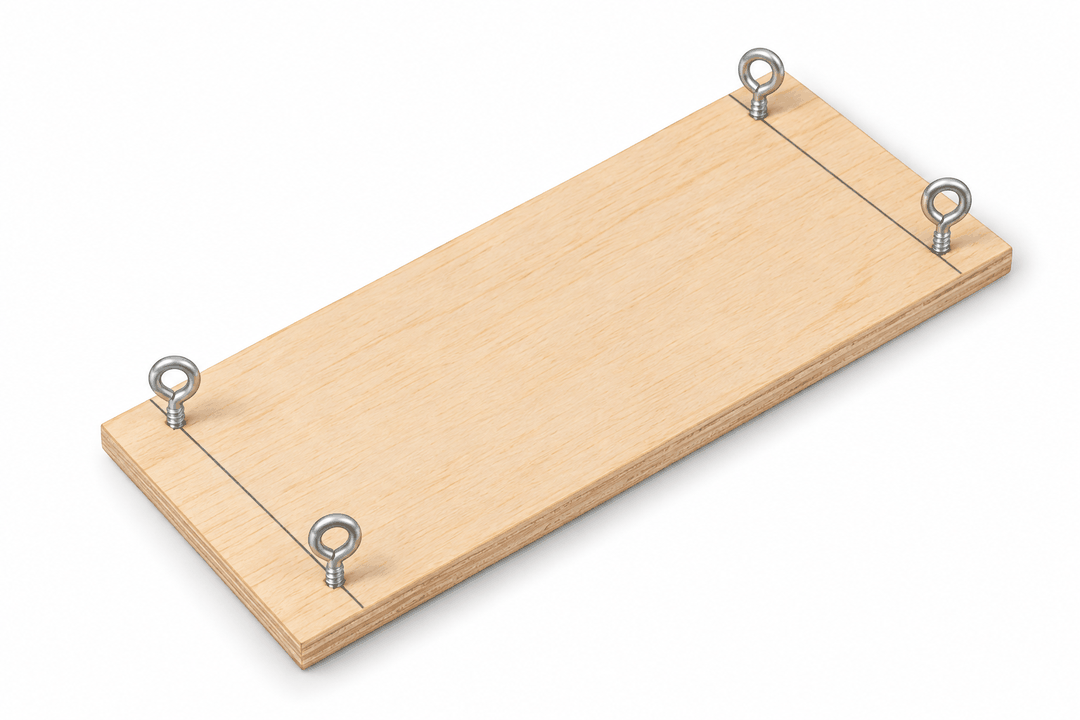
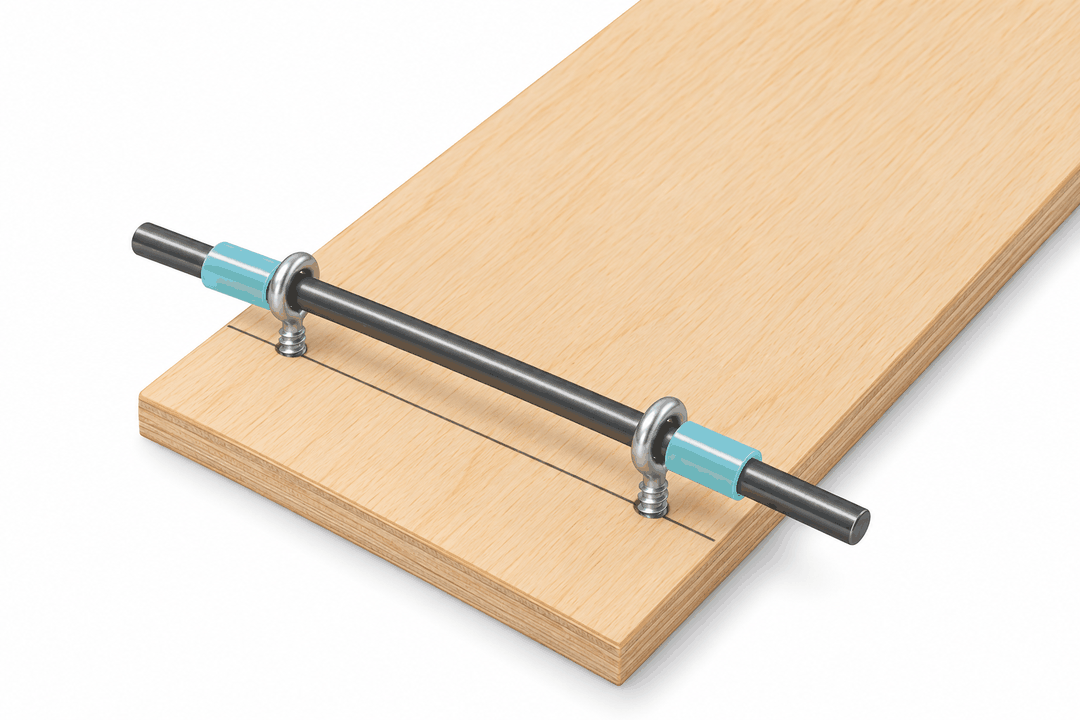
Step 1 — Mark the axles and insert the eye screws.Paso 1 — Marca los ejes y coloca las armellas. Cut a strip of wood that is 2" (5 cm) wide. Mark the location of the axles by drawing two lines, one at each end of the car, parallel to the front and back sides. On each axle line, mark two points 1/4" (6 mm) away from each side, and insert one eye screw at each point. Corta una tira de madera de 2" (5 cm) de ancho. Marca la ubicación de los ejes trazando dos líneas, una en cada extremo del carro, paralelas a los lados delantero y trasero. Sobre cada línea de eje, marca dos puntos a 1/4" (6 mm) de cada borde y enrosca una armella en cada punto.
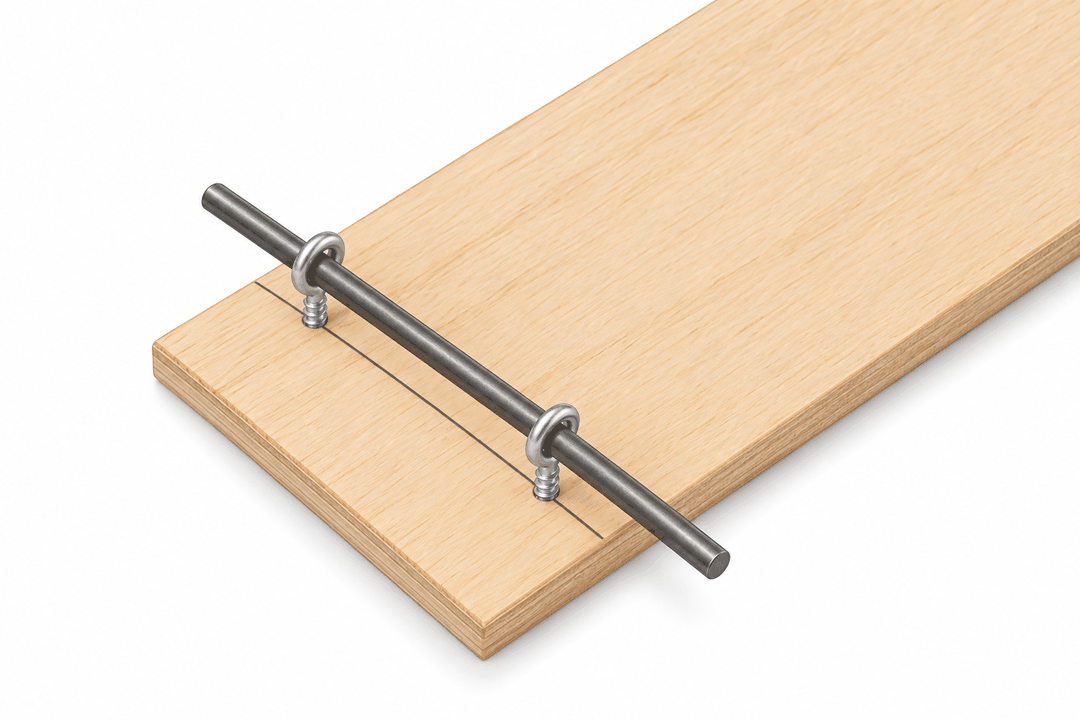
Step 2 — Insert the axle.Paso 2 — Inserta el eje. The eye screws hold the axles. Insert the axle and make sure it is level and can spin freely. If necessary, adjust the eye screws. Las armellas sostienen los ejes. Inserta el eje y asegúrate de que quede nivelado y pueda girar libremente. Si hace falta, ajusta las armellas.
Step 3 — Add the spacers.Paso 3 — Coloca los separadores. Cut short pieces of plastic tube or straw and slide them onto the axle as spacers on both sides. Corta trozos cortos de tubo de plástico o de pajilla y colócalos en el eje como separadores a ambos lados.
Step 4 — Insert the wheels.Paso 4 — Coloca las ruedas. Push the wheels onto both ends of the axle. The wheels may be inserted while the axle is already in position. Coloca las ruedas en ambos extremos del eje. Puedes colocarlas con el eje ya en su lugar.
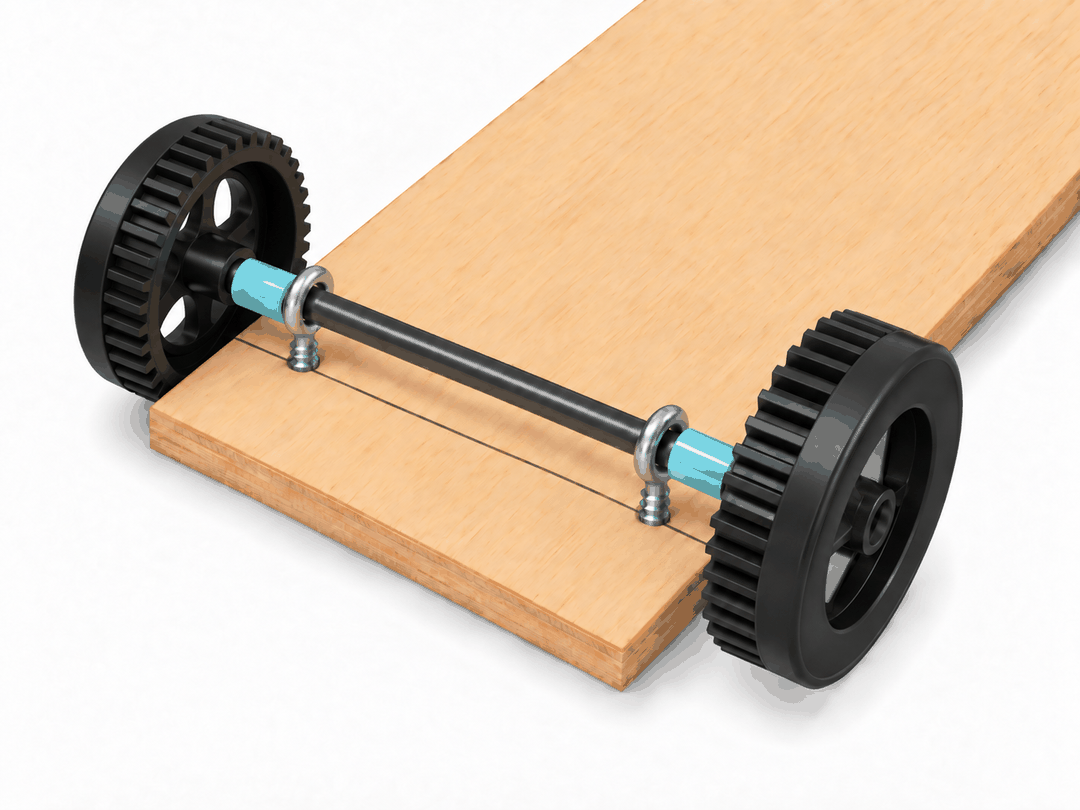
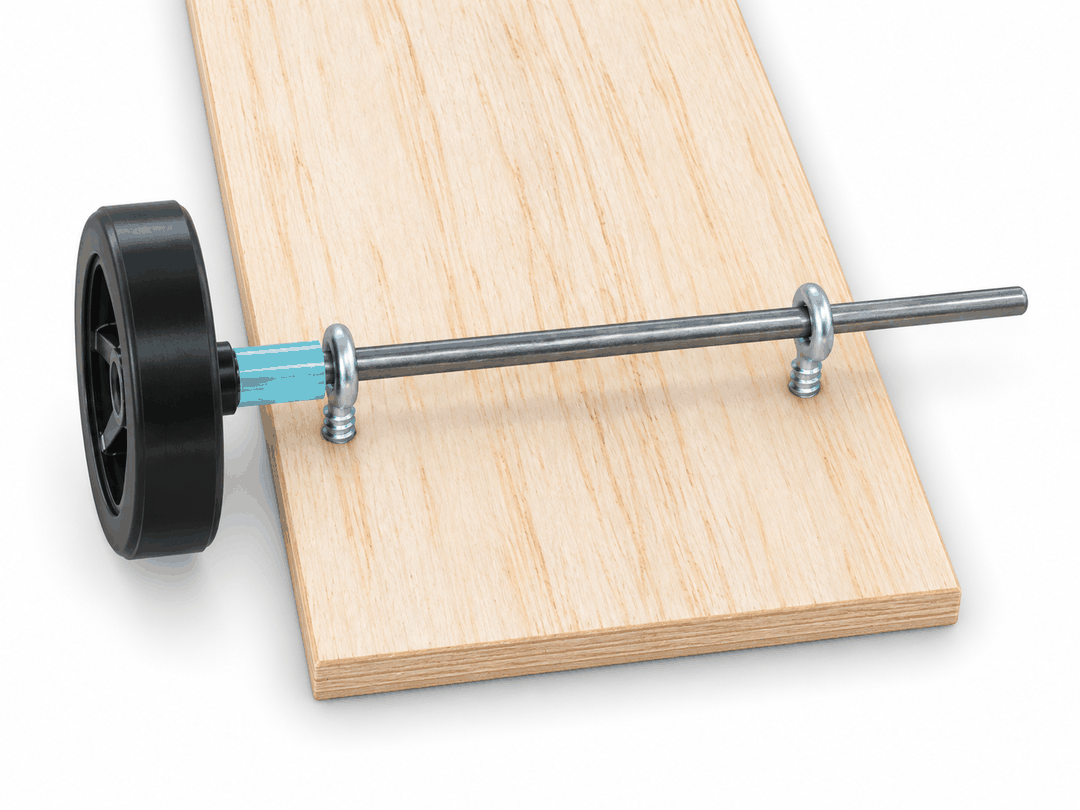
Tip — Another way to insert the wheels.Consejo — Otra forma de colocar las ruedas. You can also insert the axle into one wheel first, and then pass it through the eye screws. También puedes insertar primero el eje en una rueda y luego pasarlo por las armellas.
Step 5 — Check the chassis.Paso 5 — Revisa el chasis. When both axles are mounted, your simple car will look like this. Make sure all four wheels spin freely. You can use it the way it is, or turn it over as shown in the next step. Con los dos ejes montados, tu carro sencillo se verá así. Asegúrate de que las cuatro ruedas giren libremente. Puedes usarlo tal como está o darle la vuelta como se muestra en el siguiente paso.
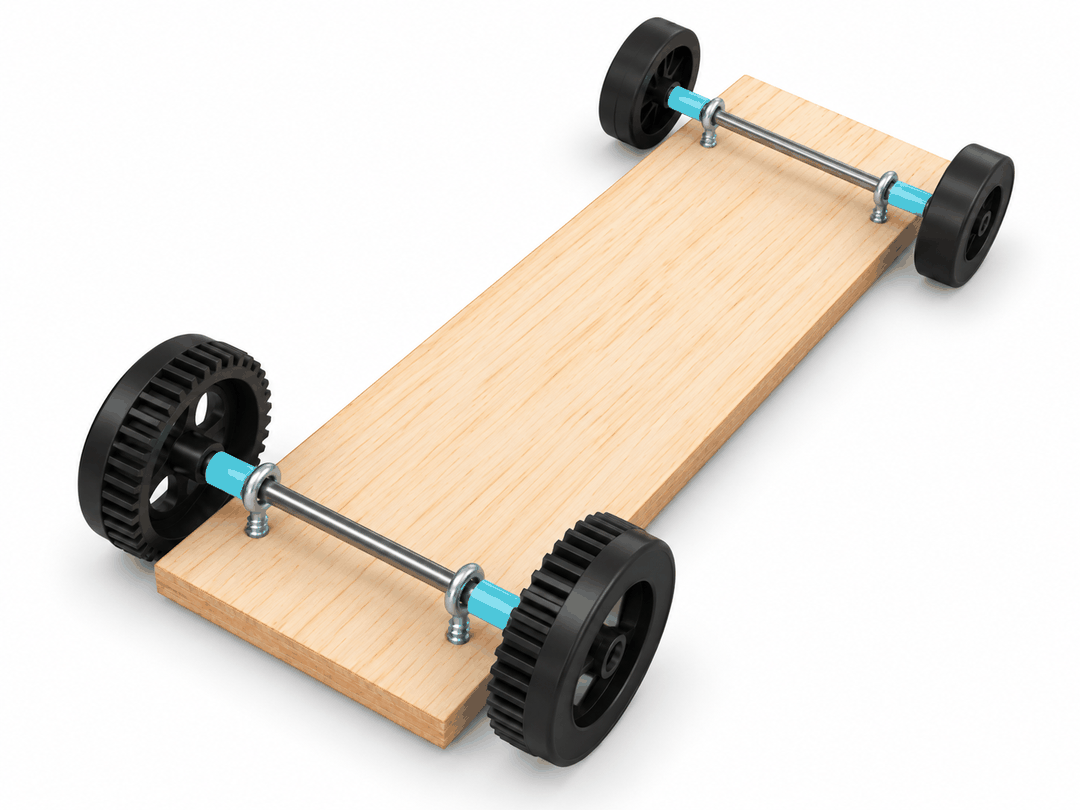
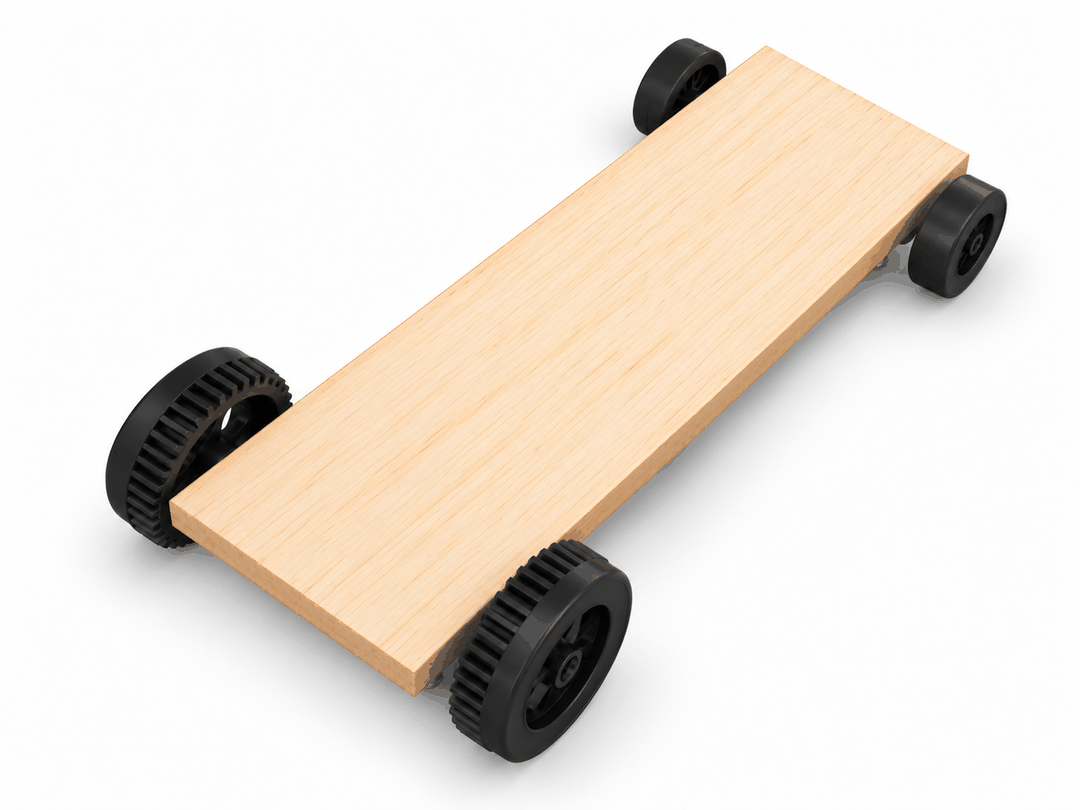
Step 6 — Turn the chassis over.Paso 6 — Dale la vuelta al chasis. In the model shown here, the gears are built into the rear slicks (rear wheels). With plain wheels, you have to add a pulley or gear on the same axle as one wheel (steps 7 to 9). If you don't need to install pulleys or gears, continue with Part 2. En el modelo que se muestra, los engranajes vienen integrados en las ruedas traseras. Con ruedas lisas, debes añadir una polea o un engranaje en el mismo eje que una de las ruedas (pasos 7 a 9). Si no necesitas instalar poleas ni engranajes, continúa con la Parte 2.
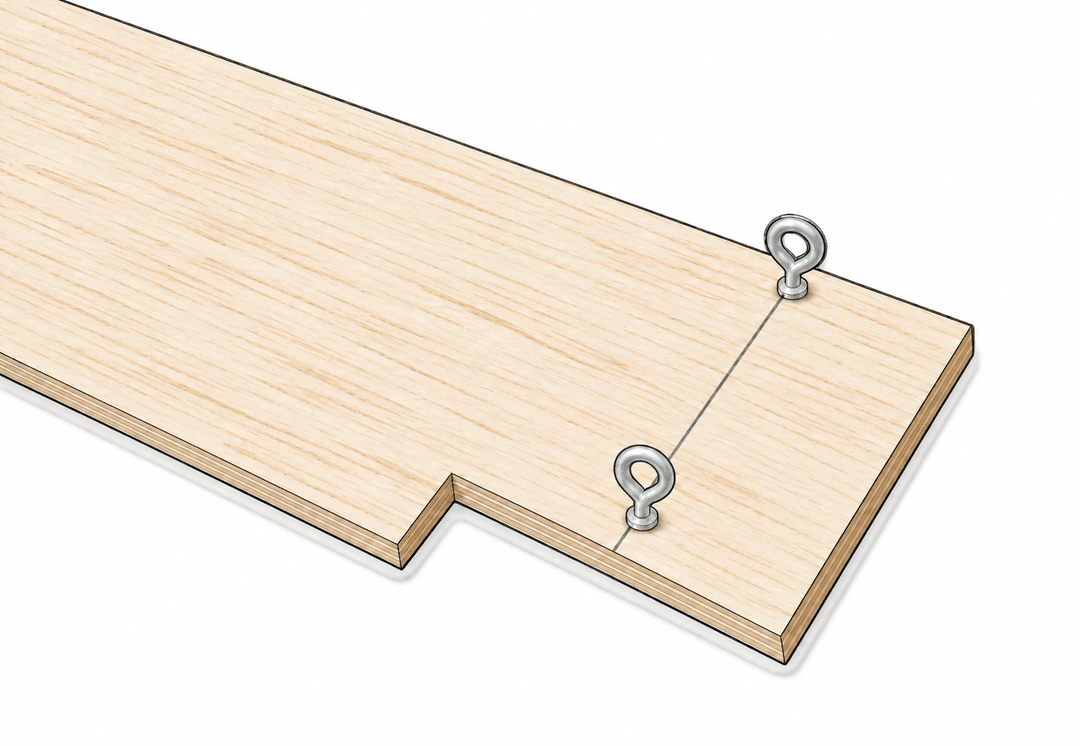
Step 7 — Cut space for a pulley or gear (plain wheels only).Paso 7 — Haz espacio para una polea o engranaje (solo ruedas lisas). To mount a pulley or gear next to one wheel, it is a good idea to cut some space for it on your chassis; otherwise one wheel will stand out and your model will not have a symmetrical shape. The size of this space depends on the size of your pulley or gear (a 3/8" × 1 1/2" cut is shown in this example). Para montar una polea o un engranaje junto a una rueda, conviene recortar un espacio en el chasis; de lo contrario, una rueda sobresaldrá y tu modelo no quedará simétrico. El tamaño de este espacio depende del tamaño de tu polea o engranaje (en este ejemplo se muestra un corte de 3/8" × 1 1/2").
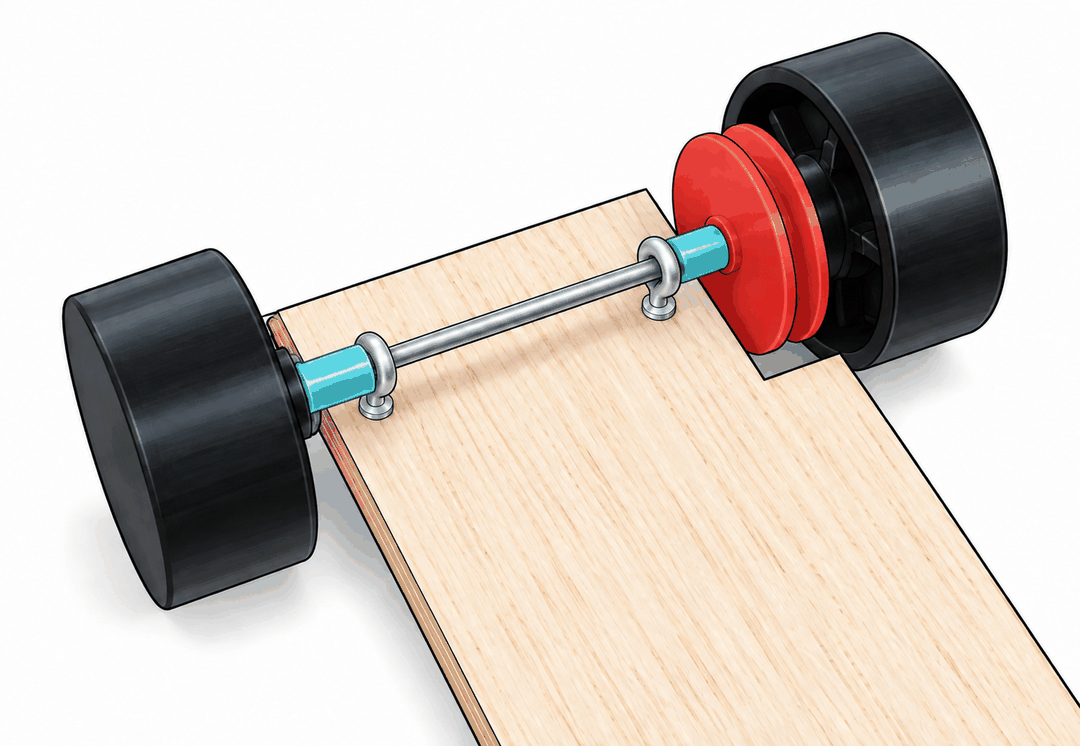
Step 8 — Mount the pulley or gear.Paso 8 — Monta la polea o el engranaje. This is how a pulley may be mounted beside one of the wheels, inside the notch. The pulley or gear must have a hole matching the axle diameter and must fit snugly. Some pulleys and gears need a plastic insert and some drilling to adapt them to the diameter of the axle you are using. Así se puede montar una polea junto a una de las ruedas, dentro del recorte. La polea o el engranaje debe tener un orificio del mismo diámetro que el eje y quedar bien ajustado. Algunas poleas y engranajes necesitan un inserto de plástico y algo de perforación para adaptarse al diámetro del eje que estás usando.
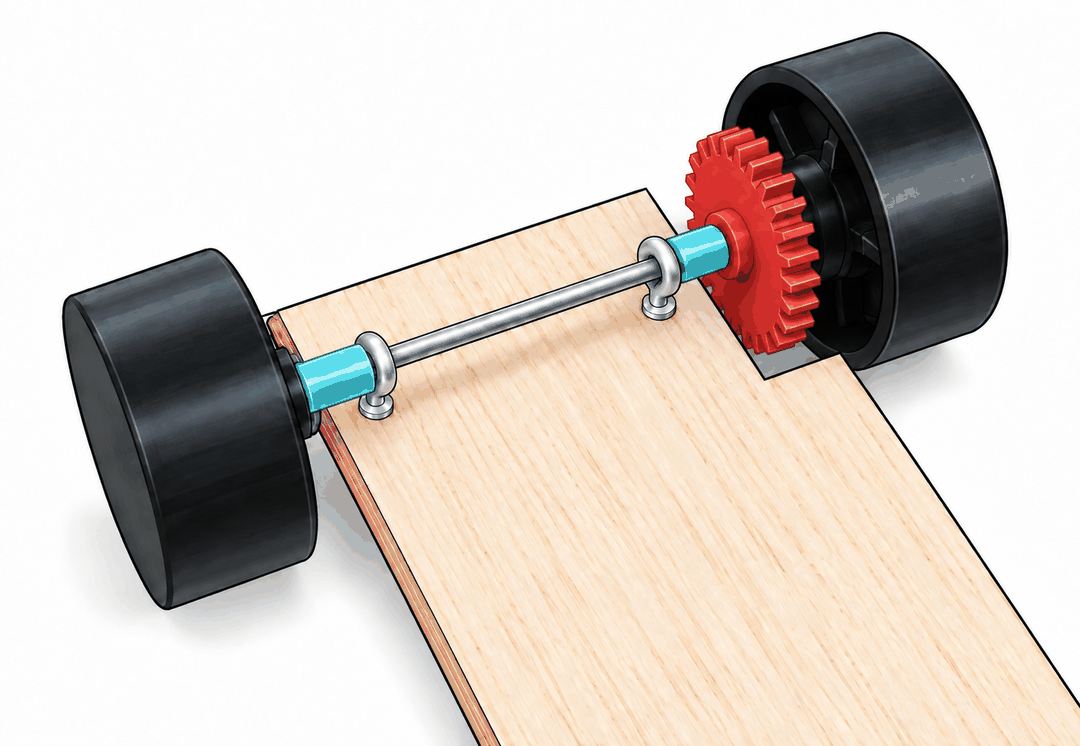
Step 9 — Check that the wheels spin freely.Paso 9 — Verifica que las ruedas giren libremente. A gear is mounted the same way. After mounting, make sure that the wheels can spin freely. If necessary, place a metal washer between the spacer and the eye screw. Un engranaje se monta de la misma manera. Después de montarlo, asegúrate de que las ruedas puedan girar libremente. Si hace falta, coloca una arandela metálica entre el separador y la armella.
Part 2 — Mount the motor Parte 2 — Monta el motor
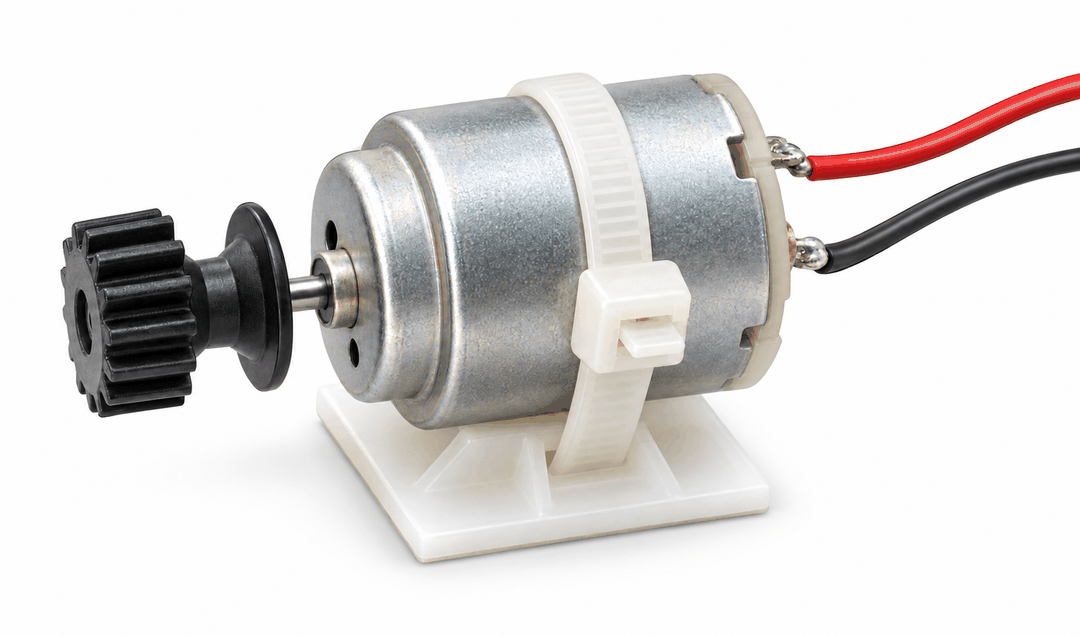
Step 10 — Strap the motor.Paso 10 — Sujeta el motor. Insert the small gear or pulley onto the motor's shaft. Place the motor on the self-adhesive motor mount and strap it securely and snugly. Coloca el engranaje pequeño o la polea en el eje del motor. Pon el motor sobre el soporte autoadhesivo y sujétalo firmemente con el cincho.
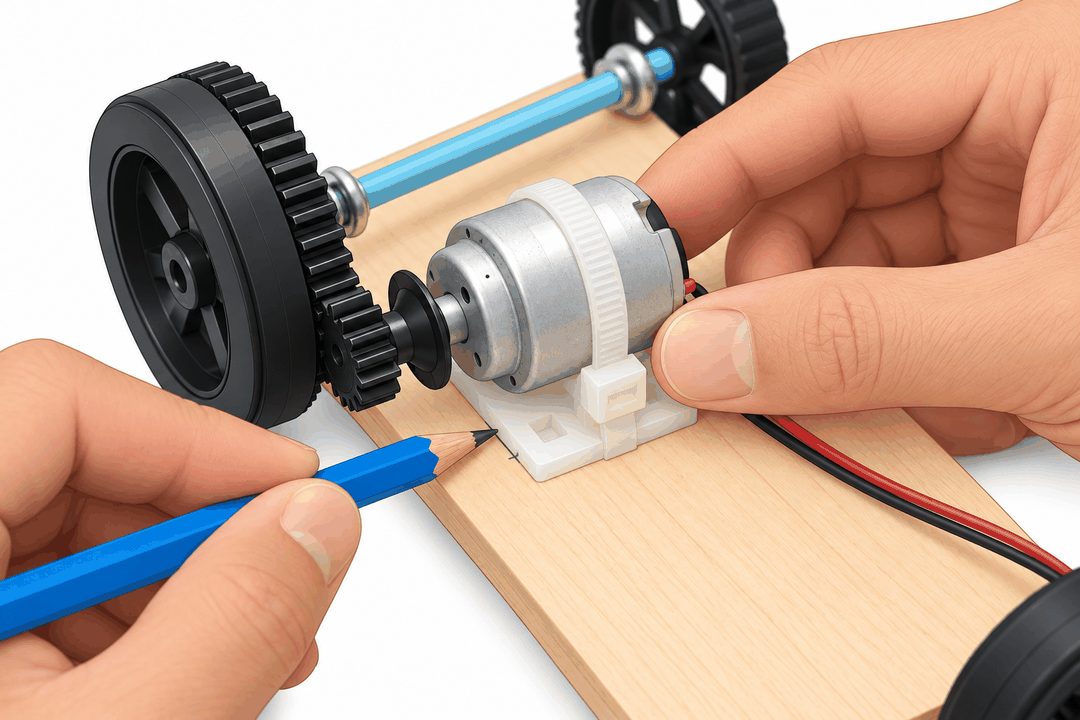
Step 11 — Mark the motor position.Paso 11 — Marca la posición del motor. Place the motor on the car while the car is on a flat surface. Move it toward the rear gear until the gears engage, then mark the location of the motor. Avoid too much pressure on the gears, because it increases the friction and makes it difficult for the car to move. Coloca el motor sobre el carro mientras este está sobre una superficie plana. Acércalo al engranaje trasero hasta que los engranajes encajen y marca la posición del motor. Evita presionar demasiado los engranajes, porque eso aumenta la fricción y le cuesta más al carro moverse.
Using pulleys? Mount the motor away from the pulley so that the rubber belt is slightly stretched. ¿Usas poleas? Monta el motor alejado de la polea para que la banda elástica quede ligeramente estirada.
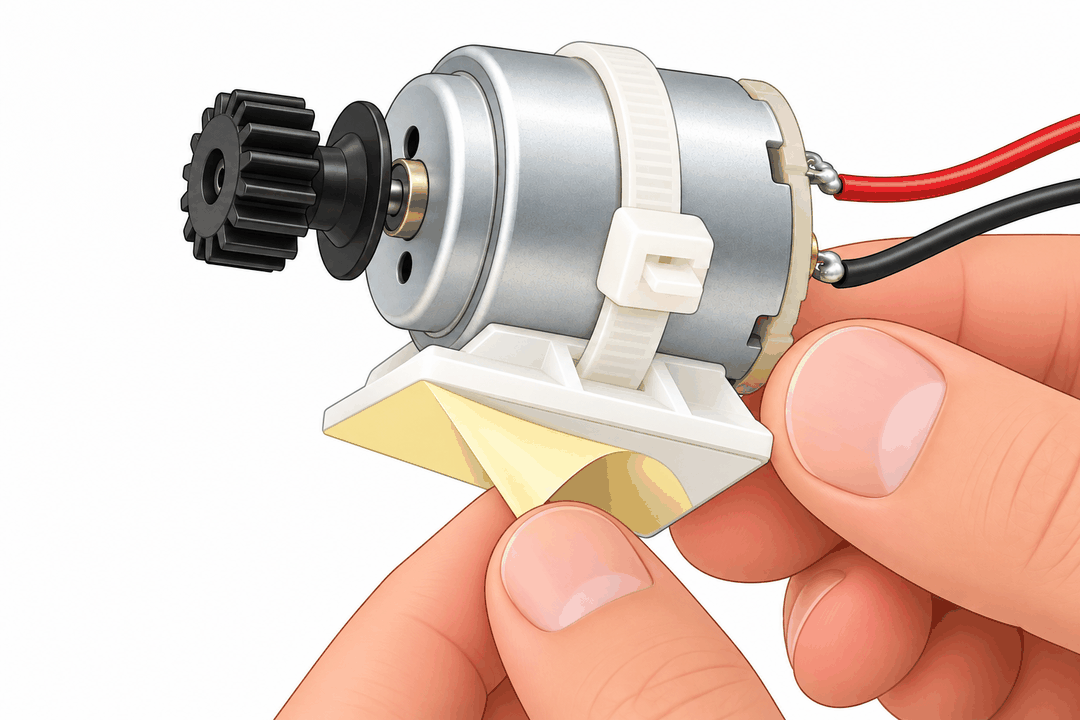
Step 12 — Stick the motor mount in place.Paso 12 — Pega el soporte del motor. Carefully peel off the protective cover of the adhesive pad, making sure you do not remove the adhesive pad itself. Place the motor where you marked it and push it down firmly so it sticks in place. Retira con cuidado la cubierta protectora de la almohadilla adhesiva, sin quitar la almohadilla misma. Coloca el motor donde lo marcaste y presiónalo con firmeza para que quede pegado.
Part 3 — Mount the solar panel Parte 3 — Monta el panel solar
Step 13 — Connect the solar panel.Paso 13 — Conecta el panel solar. Place the solar panel on the car and connect its wires to the motor terminals, if they are not already connected. You can twist the wires together with pliers or solder them. Route the wires under the panel so they stay hidden and away from the gears. Coloca el panel solar sobre el carro y conecta sus cables a los terminales del motor, si no vienen ya conectados. Puedes torcer los cables con pinzas o soldarlos. Pasa los cables por debajo del panel para que queden ocultos y lejos de los engranajes.
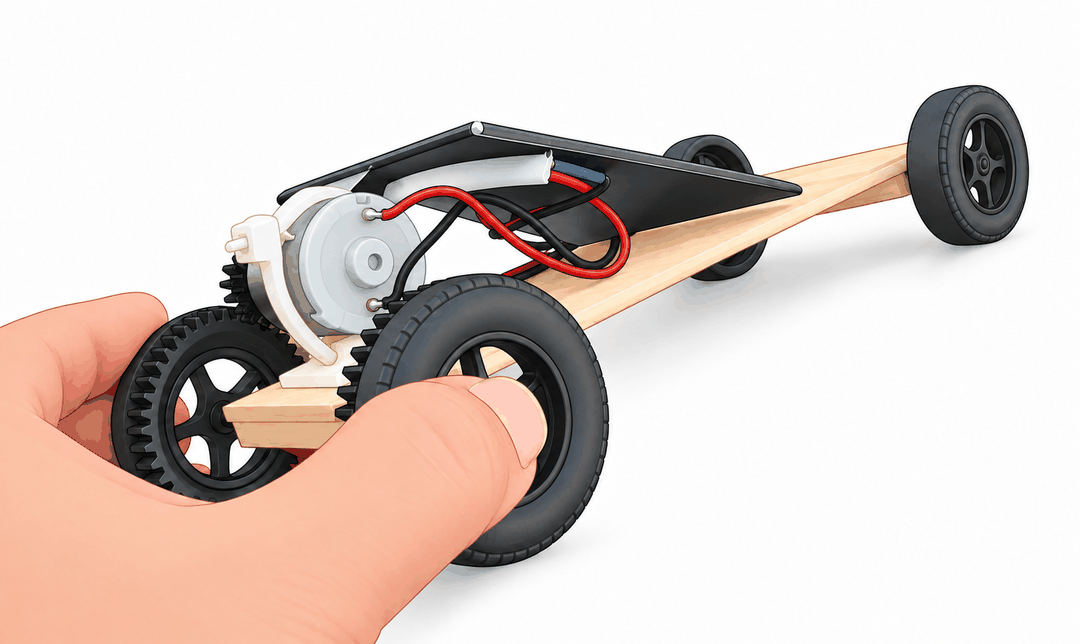
Step 14 — Secure the panel and test the car.Paso 14 — Fija el panel y prueba el carro. The solar panel may be mounted horizontally or slanted. Secure it in place with a few pieces of clear tape. El panel solar puede montarse horizontal o inclinado. Fíjalo con unos trozos de cinta transparente.
Take the car outside to a sunny location and test it. Does the motor run while you hold the car in your hand? Do the wheels spin? Now place the car on a smooth, flat surface with the solar panel facing the sun. Does it run on the ground?
Saca el carro a un lugar soleado y pruébalo. ¿Funciona el motor mientras sostienes el carro en la mano? ¿Giran las ruedas? Ahora colócalo sobre una superficie lisa y plana con el panel solar orientado hacia el sol. ¿Avanza sobre el suelo?
Step 15 — Decorate your car.Paso 15 — Decora tu carro. The final solar car you make may be different based on the materials you use, your design and the decorations you add. Decorations may include wooden or cardboard pieces, markers or paint. El carro solar que construyas puede ser distinto según los materiales que uses, tu diseño y las decoraciones que añadas. Puedes decorarlo con piezas de madera o cartón, marcadores o pintura.
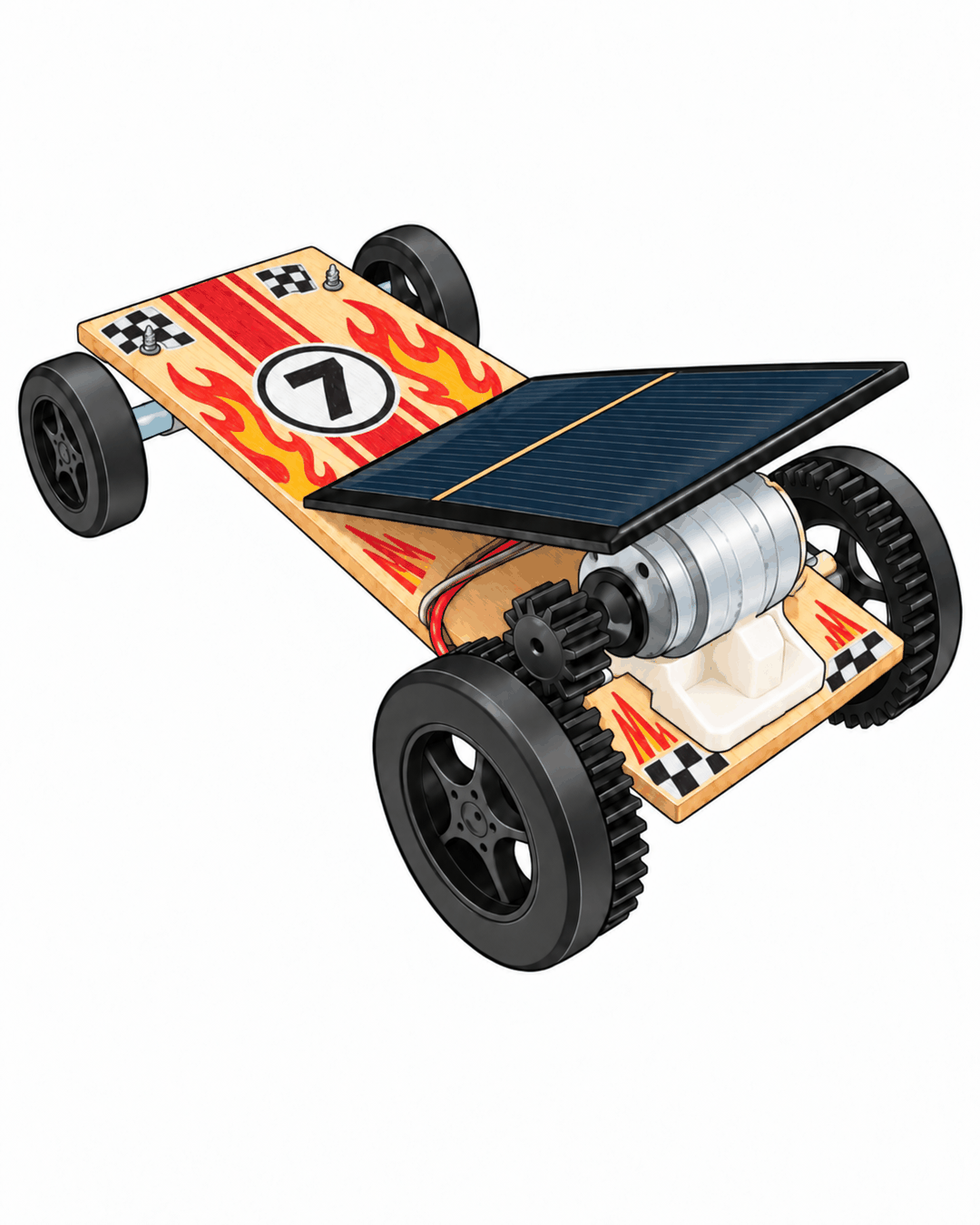
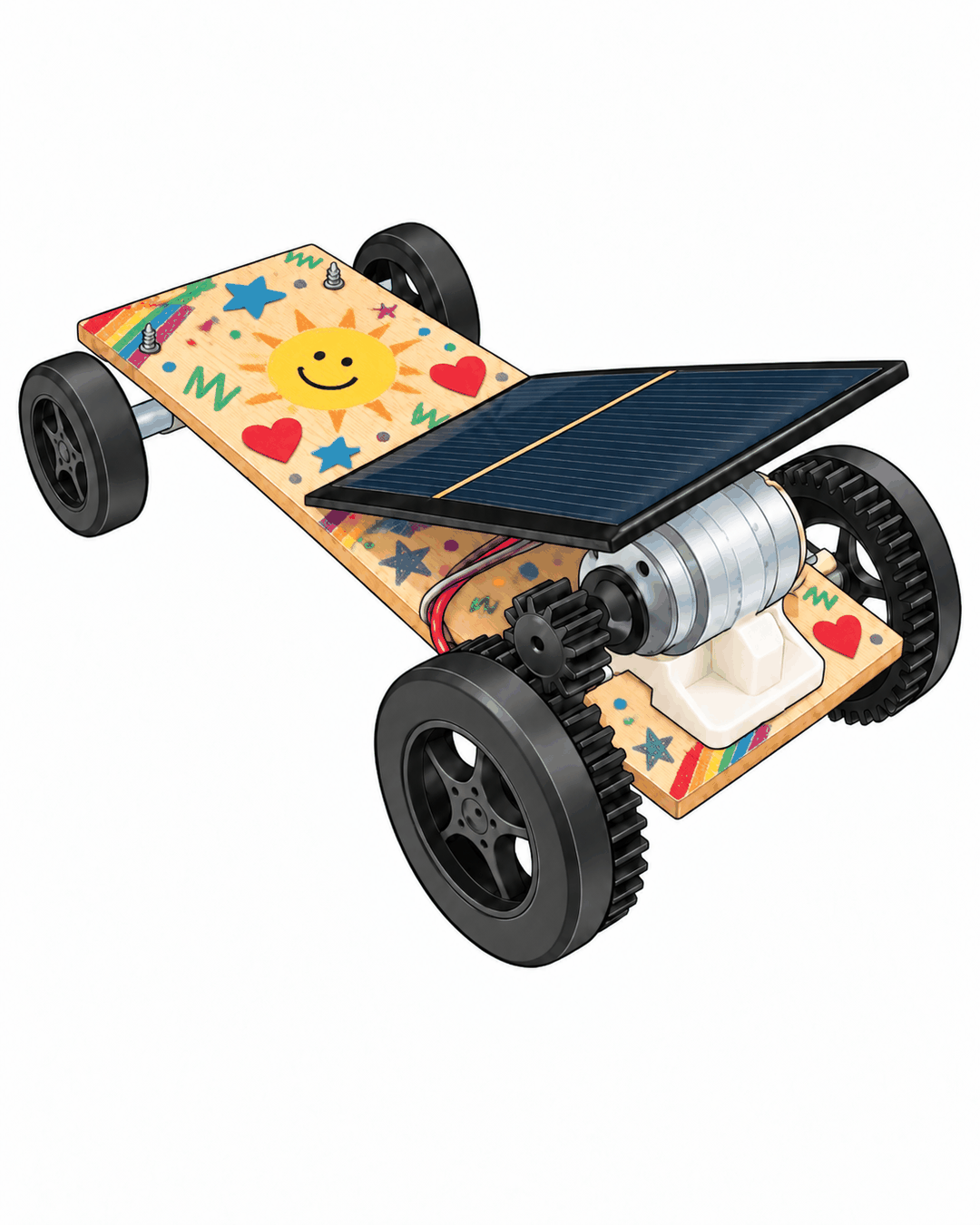
Test your car indoors: you can replace the sunlight with a strong portable light (a contractor's work light) from a hardware store. Position the lamp about 2 feet (60 cm) above the car and see how it works. For best results, the lamp must have a bulb of at least 120 watts and a reflector. The lamp gets very hot: do not touch it, and keep it away from paper and from the car's body.
Prueba tu carro en interiores: puedes reemplazar la luz del sol por una lámpara portátil potente (una lámpara de trabajo de ferretería). Colócala a unos 2 pies (60 cm) por encima del carro y observa cómo funciona. Para obtener mejores resultados, la lámpara debe tener un foco de al menos 120 watts y un reflector. La lámpara se calienta mucho: no la toques y mantenla lejos del papel y de la carrocería del carro.
Other Methods of Mounting the Axles Otros Métodos para Montar los Ejes
You may not have eye screws for mounting the axles. This is an alternate method for mounting the wheels and axles, using a straw as the axle holder.
Es posible que no tengas armellas para montar los ejes. Este es un método alternativo para montar las ruedas y los ejes, usando una pajilla como soporte del eje.
A1 — Build the axle assembly.A1 — Arma el conjunto del eje. Insert the axle into one wheel and slide a washer onto it. Slide a piece of straw over the axle, and finally add another washer and another wheel. Inserta el eje en una rueda y coloca una arandela. Pasa un trozo de pajilla sobre el eje y, por último, coloca otra arandela y otra rueda.
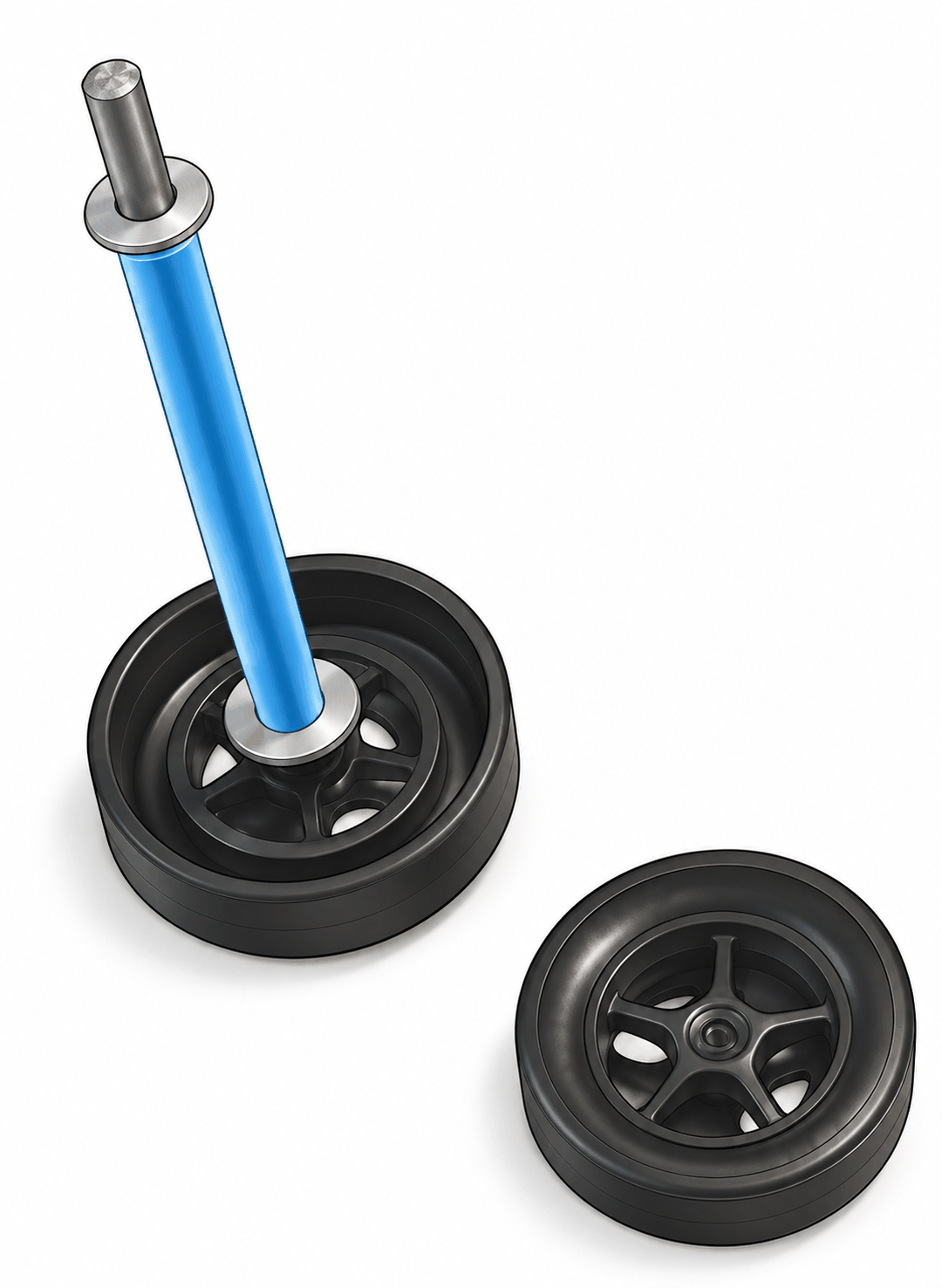
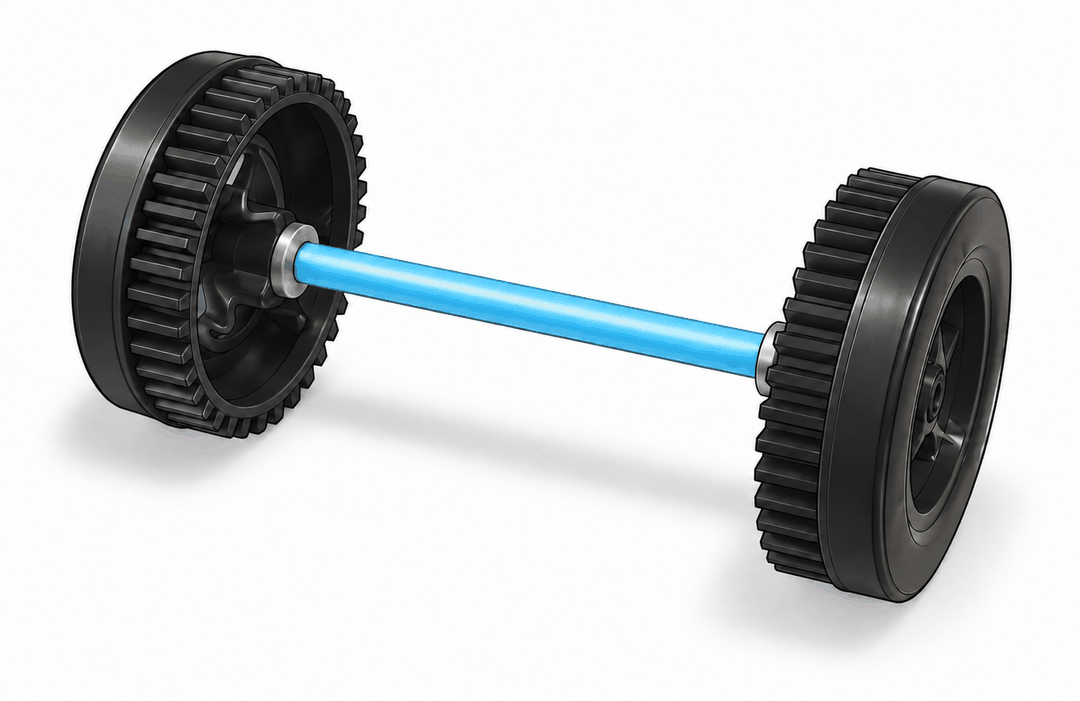
A2 — Check the wheels.A2 — Revisa las ruedas. Your finished wheels and axle will look like this. Hold the straw and spin the wheels. Make sure the wheels can spin freely; if necessary, make some adjustments. Tus ruedas y tu eje terminados se verán así. Sujeta la pajilla y haz girar las ruedas. Asegúrate de que giren libremente; si hace falta, haz algunos ajustes.
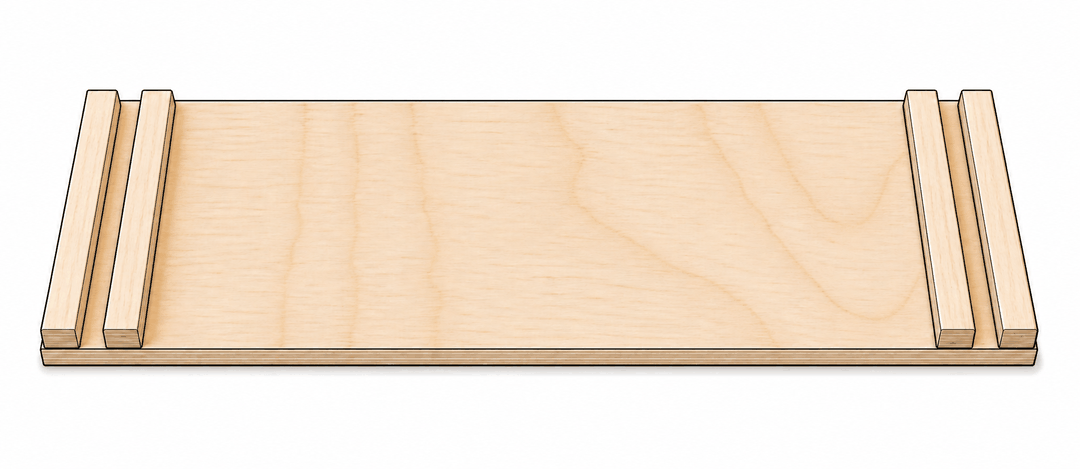
A3 — Glue the axle holders.A3 — Pega los soportes del eje. Cut 4 pieces of wood strip, each 2" (5 cm) long, and glue them in pairs, about 5 mm (3/16") apart, where you want to mount the axles. Corta 4 trozos de listón de madera de 2" (5 cm) de largo y pégalos en pares, separados unos 5 mm (3/16"), donde quieras montar los ejes.
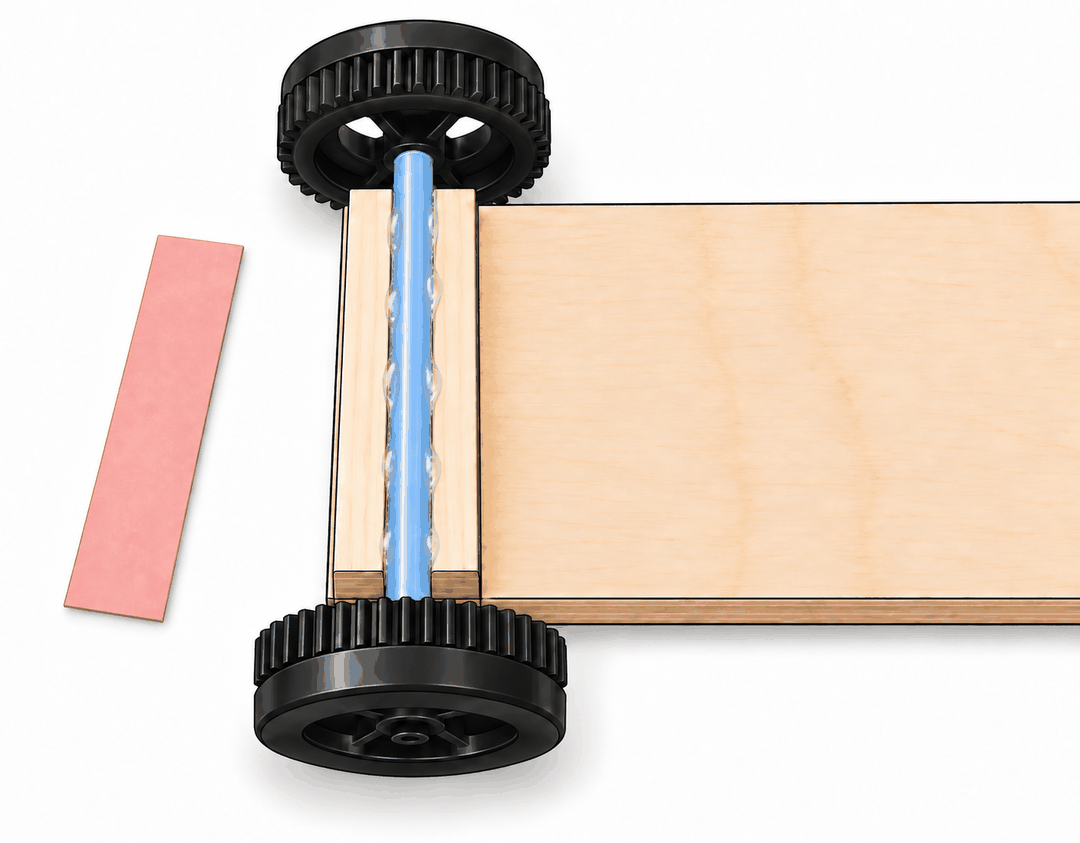
A4 — Glue the axle in place.A4 — Pega el eje en su lugar. Insert the axle assembly in the space between the strips and secure the straw in place with some glue. Cover it with a strip of cardboard or heavy construction paper. Coloca el conjunto del eje en el espacio entre los listones y fija la pajilla con un poco de pegamento. Cúbrelo con una tira de cartón o de cartulina gruesa.
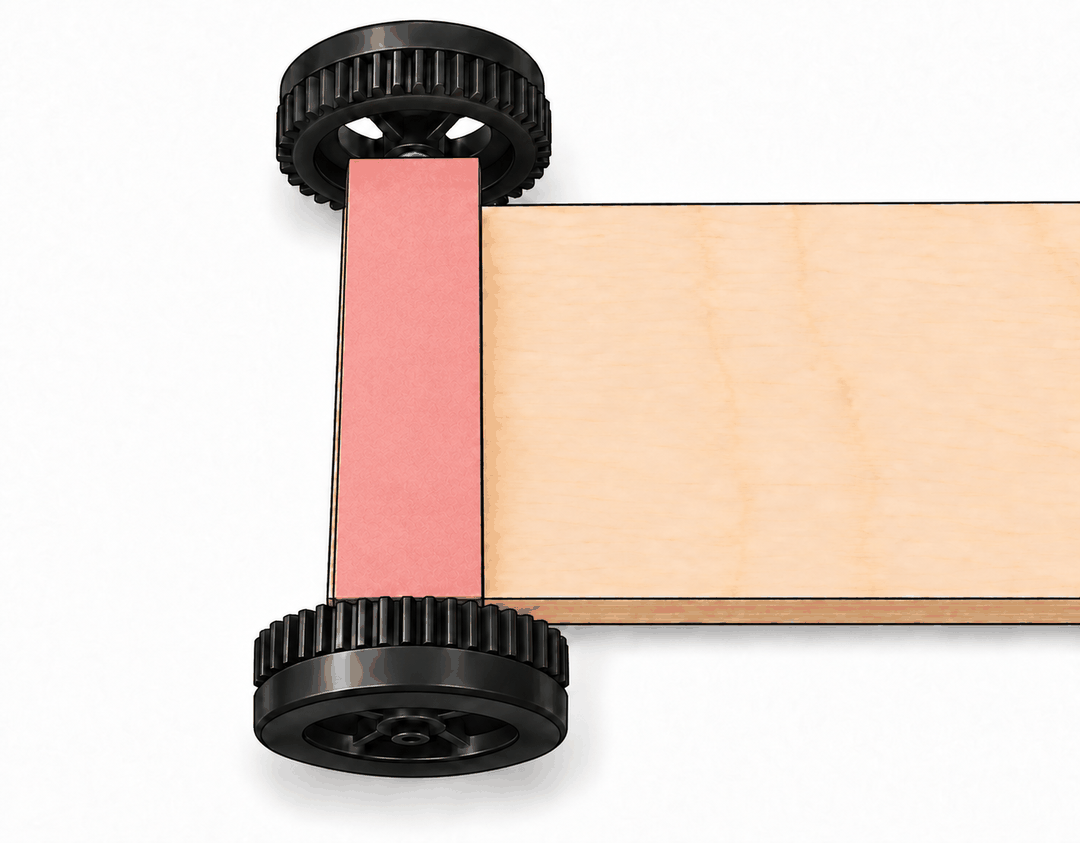
A5 — Finished axle holder.A5 — Soporte del eje terminado. Note that the glue touches the straw, not the axle, so the axle can still spin. This is how the bottom of your car will look after covering the axle holder with a strip of paper. Observa que el pegamento toca la pajilla y no el eje, para que el eje pueda seguir girando. Así se verá la parte inferior de tu carro después de cubrir el soporte del eje con una tira de papel.
Classroom Design Procedure Procedimiento de Diseño en Clase
This alternate procedure lets students design their own gear driven solar racer. The steps below cover the construction of the basic vehicle; completing the propulsion system is left to the student's own design.
Este procedimiento alternativo permite que los estudiantes diseñen su propio carro solar con transmisión por engranajes. Los pasos cubren la construcción del vehículo básico; el sistema de propulsión se completa según el diseño de cada estudiante.
- Make sure your kit contains all the items listed.
- Locate the grid planning sheet in the kit.
- Using a pencil and a ruler, design the body of the vehicle and its propulsion system. Remember: the lighter the vehicle's body, the farther it will travel.
- Show the drawing to the teacher when it is ready.
- Locate the wood sheet in the kit.
- Transfer the vehicle body pattern to the wood sheet.
- Using the craft knife and a straightedge, carefully cut out the vehicle body.
- Locate the straw in the kit, and get a pair of scissors and the glue gun.
- Cut the straw in half.
- Using the glue gun, attach the straws to the bottom of the vehicle, one at each end, parallel to the end.
- Locate the axles.
- Push one wheel onto each axle.
- Insert an axle through each straw.
- Carefully place the remaining wheel onto each axle. This completes the construction of the basic solar vehicle.
- Locate the solar panel and the parts required for the propulsion system you chose: gears, pulleys, propeller or rubber band. (Gears are supplied; pulleys and propellers are optional.)
- Assemble and attach the propulsion system as designed.
- Finish your solar racer as desired, using paint, markers, etc.
- Race the assembled vehicle on a flat surface on a sunny day.
- Asegúrate de que tu kit contenga todos los materiales de la lista.
- Busca en el kit la hoja cuadriculada de planificación.
- Con un lápiz y una regla, diseña la carrocería del vehículo y su sistema de propulsión. Recuerda: cuanto más liviana sea la carrocería, más lejos llegará.
- Muestra el dibujo al docente cuando esté listo.
- Busca la lámina de madera del kit.
- Traslada el patrón de la carrocería a la lámina de madera.
- Con el cúter y una regla metálica, recorta con cuidado la carrocería.
- Busca la pajilla del kit y ten a mano unas tijeras y la pistola de silicón.
- Corta la pajilla por la mitad.
- Con la pistola de silicón, pega las pajillas en la parte inferior del vehículo, una en cada extremo y paralela a ese extremo.
- Busca los ejes.
- Coloca una rueda en cada eje.
- Pasa un eje por cada pajilla.
- Coloca con cuidado la rueda restante en cada eje. Con esto termina la construcción del vehículo solar básico.
- Busca el panel solar y las piezas necesarias para el sistema de propulsión elegido: engranajes, poleas, hélice o banda elástica. (Los engranajes vienen incluidos; las poleas y las hélices son opcionales.)
- Arma e instala el sistema de propulsión según tu diseño.
- Decora tu carro solar como quieras, con pintura, marcadores, etc.
- Haz correr el vehículo sobre una superficie plana en un día soleado.
Competition Categories Categorías de Competencia
Competition between students can be based on design, drawings, final appearance, distance traveled, speed, etc. Races can be held between cars with similar or different types of propulsion systems.
La competencia entre estudiantes puede basarse en el diseño, los dibujos, la apariencia final, la distancia recorrida, la velocidad, etc. Se pueden organizar carreras entre carros con sistemas de propulsión iguales o diferentes.
In addition, teachers can add a problem-solving category for advanced or older students: give the students the solar racer kit and ask them to use additional classroom materials to build a customized solar vehicle. Additional items could include wood scraps, stickers, paint, CDs, colored wheels and more. How elaborate the solar cars become depends on imagination and resources.
Además, los docentes pueden añadir una categoría de resolución de problemas para estudiantes avanzados o mayores: entregarles el kit del carro solar y pedirles que usen materiales adicionales del salón para construir un vehículo solar personalizado. Los materiales adicionales pueden incluir retazos de madera, calcomanías, pintura, CD, ruedas de colores y más. Qué tan elaborados sean los carros solares depende de la imaginación y de los recursos.
Science Project Proyecto Científico
Research question:Pregunta de investigación: How does the amount of solar panel area exposed to sunlight affect the speed of the solar car? ¿Cómo afecta la cantidad de superficie del panel solar expuesta a la luz del sol a la velocidad del carro solar?
Sample hypothesis 1:Hipótesis de ejemplo 1: I hypothesize that covering part of the solar panel has no effect on the speed of the car. Mi hipótesis es que cubrir parte del panel solar no afecta a la velocidad del carro.
Sample hypothesis 2:Hipótesis de ejemplo 2: I hypothesize that the car will move slower as more of the solar panel is covered, because a smaller lit area produces less electricity for the motor. Mi hipótesis es que el carro irá más lento cuanto más se cubra el panel solar, porque una superficie iluminada más pequeña produce menos electricidad para el motor.
Experiment (Observation and Reporting) Experimento (Observación y Reporte)
- On a sunny day, find a smooth, flat and level surface outdoors. Mark a start line and a finish line 3 meters (about 10 feet) apart.
- With the solar panel fully uncovered, place the car behind the start line with the panel facing the sun, release it, and use a stopwatch to measure the time it takes to reach the finish line.
- Repeat the same trial three times and calculate the average time.
- Cover one quarter of the solar panel with a piece of cardboard, held in place with a small piece of tape, and repeat steps 2 and 3.
- Cover one half of the solar panel and repeat steps 2 and 3.
- Run all the trials within a short time (for example, 30 minutes) so the sunlight stays about the same, and aim the car in the same direction every time.
- Calculate the speed for each case: speed = distance ÷ average time.
- En un día soleado, busca al aire libre una superficie lisa, plana y nivelada. Marca una línea de salida y una línea de llegada separadas 3 metros (unos 10 pies).
- Con el panel solar totalmente descubierto, coloca el carro detrás de la línea de salida con el panel orientado hacia el sol, suéltalo y mide con un cronómetro el tiempo que tarda en llegar a la meta.
- Repite la misma prueba tres veces y calcula el tiempo promedio.
- Cubre una cuarta parte del panel solar con un trozo de cartón, sujeto con un pedacito de cinta, y repite los pasos 2 y 3.
- Cubre la mitad del panel solar y repite los pasos 2 y 3.
- Haz todas las pruebas en poco tiempo (por ejemplo, 30 minutos) para que la luz del sol se mantenga casi igual, y orienta el carro siempre en la misma dirección.
- Calcula la velocidad de cada caso: velocidad = distancia ÷ tiempo promedio.
Record your readings in the table below:
Anota tus mediciones en la siguiente tabla:
| Solar panel | Average time for 3 m (seconds) | Speed (m/s) |
|---|---|---|
| Uncovered | ||
| 1/4 covered | ||
| 1/2 covered |
| Panel solar | Tiempo promedio en 3 m (segundos) | Velocidad (m/s) |
|---|---|---|
| Descubierto | ||
| 1/4 cubierto | ||
| 1/2 cubierto |
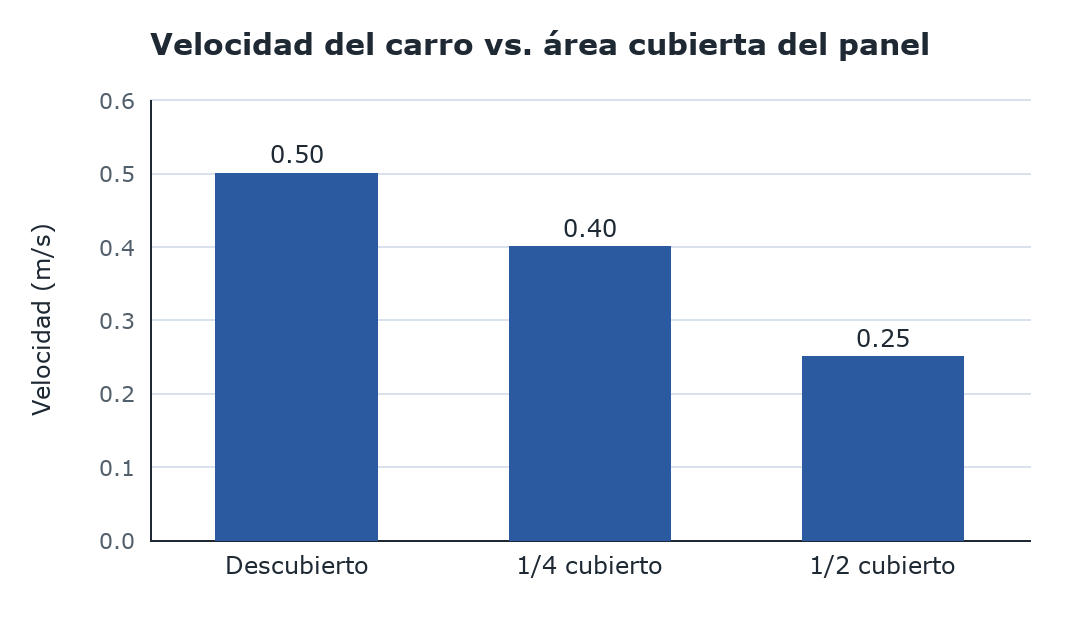
Sample data tableTabla de datos de ejemplo (Values are not real)(Los valores no son reales):
| Solar panel | Average time for 3 m (seconds) | Speed (m/s) |
|---|---|---|
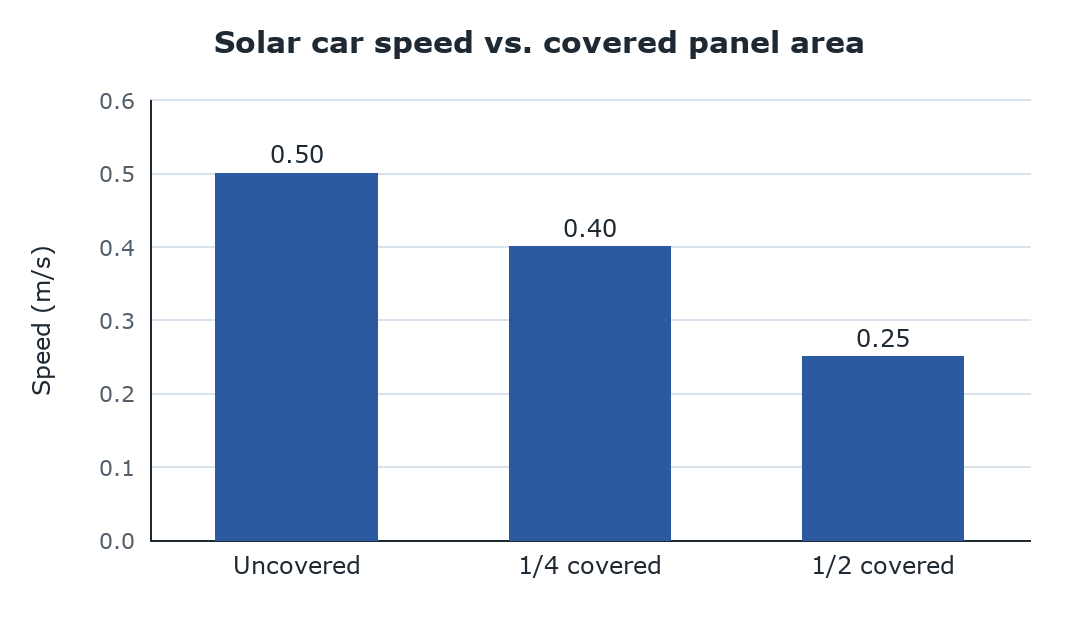
| Uncovered | 6.0 | 0.50 |
| 1/4 covered | 7.5 | 0.40 |
| 1/2 covered | 12.0 | 0.25 |
| Panel solar | Tiempo promedio en 3 m (segundos) | Velocidad (m/s) |
|---|---|---|
| Descubierto | 6.0 | 0.50 |
| 1/4 cubierto | 7.5 | 0.40 |
| 1/2 cubierto | 12.0 | 0.25 |
Analysis and Reporting Análisis y Reporte
Review the times and speeds you recorded in the data table and discuss whether covering part of the solar panel changed the speed of the car. Explain how the amount of light reaching the panel affects the electricity it produces and, in turn, how fast the motor turns. Discuss the other factors that could have affected your results, such as clouds passing over the sun, the angle of the panel, friction in the wheels and gears, and the weight of the car.
Revisa los tiempos y las velocidades que anotaste en la tabla y comenta si cubrir parte del panel solar cambió la velocidad del carro. Explica cómo la cantidad de luz que llega al panel afecta a la electricidad que produce y, a su vez, a la velocidad con que gira el motor. Comenta otros factores que pudieron influir en tus resultados, como las nubes que pasan frente al sol, el ángulo del panel, la fricción en las ruedas y los engranajes, y el peso del carro.
Make a Graph Haz una Gráfica
Use your data/results table to draw a graph, or create one like this in Excel. Make one bar for each solar panel setting so you can visually compare the speed of the car in each case.
Usa tu tabla de datos y resultados para dibujar una gráfica, o crea una como esta en Excel. Haz una barra para cada condición del panel solar y así podrás comparar visualmente la velocidad del carro en cada caso.
If you do not have this kit or need extra parts to complete your project, you can order it now. It is available both as a single pack and as a class pack. Kit content may be different from the images shown on this page. Check price and availability at the secure online store.
Si no tienes este kit o necesitas piezas adicionales para completar tu proyecto, puedes pedirlo ahora. Está disponible en paquete individual y en paquete para el salón de clases. El contenido del kit puede ser diferente de las imágenes de esta página. Consulta precio y disponibilidad en la tienda en línea segura.
Secure Online StoreTienda en Línea Segura
Order Now / Ordenar Ahora
Gear Propulsion Solar Car Kit — Part# CARSLR1
Product URL:
https://shop.miniscience.com/CARSLR1
MiniScience.com
1059 Main Avenue
Clifton, New Jersey 07011
Tel: (973) 777-3113
Email: info@MiniScience.com